Support tailored to the situation, and committed for the long term.
One engagement can move between individual interviews, collective sessions, informal exchanges and drafting work: the formats vary with the subjects.

An engagement does not happen in a single time and place
Voicing and understanding, so that decisions can be made
It sometimes takes a confidential conversation before someone can take a position in the group. A collective agreement does not always say how it translates into roles or documents. A decision that is clear in the session can waver when it comes to be applied.
Close enough to understand
Getting close to the real world of the people, the relationships and the decisions, without becoming anyone’s permanent confidant or personal arbiter.
Far enough back to speak
Not going with the prevailing wind, and not simply reassuring whoever commissioned the engagement. Listening to the other voices and putting the real issues back on the table.
The right setting to act
Going far enough to make change possible, without provoking a confrontation the system would not yet be able to bear.
We build the engagement around those stages. The format changes with the work to be done.
One to one
Bringing out what cannot yet be said in front of the group.
The individual interview aims to grasp how each person sees the situation, what they want to protect, what they fear and the place they believe they can take. It is not about collecting confidences, but about bringing out gaps in perception, taboos, and the conditions for a useful collective conversation.
That work gives Associés en Gouvernance a truer reading of the system. It also lets each person put their position into words without having to defend it in front of the others straight away.
- Telling facts, interpretations and expectations apart.
- Understanding the official positions and the dynamics really at work.
- Preparing feedback that protects people without watering down the substance.
- Identifying what can be discussed now and what needs another approach.

As a group
Engaging people in collective work on the decisions they have to be able to take together.
A collective session is more than a series of statements: it has to bring the useful disagreements to light, clarify the subjects at stake, structure the debate and lead to decisions everyone can understand.
Associés en Gouvernance prepares the setting, chooses the level of confrontation the situation calls for, and makes sure the session is neither dominated by the most powerful person in the room nor rushed towards a consensus for show.
See
Reaching a shared reading — or at least one common enough — of the situation, the facts and the stakes.
Debate
Working on the disagreements without confusing them with personal relationships.
Decide
Setting out what has been chosen, what remains open, who takes it forward and by when.

Between stages
Being there when governance is really at stake.
Decisive moments do not always coincide with the calendar of meetings. Sometimes a board meeting has to be prepared, a heated reaction interpreted, the scope of a clause clarified, a family discussion that has shifted positions taken into account, or a decision revisited before it hardens.
The engagement can also take the form of shorter exchanges between stages, to anticipate a delicate moment or to stop a difficulty being pushed back to the next meeting by default.
The channel — a call, a video meeting, a message or a face-to-face — is chosen according to the nature of the subject and the relationship already built. The promise is about the continuity of the work, not about any particular tool.
- Preparing a meeting or a difficult intervention.
- Reviewing a decision or a document before committing to it.
- Giving quick feedback without putting the whole engagement back on the table.
- Keeping up momentum between group sessions.
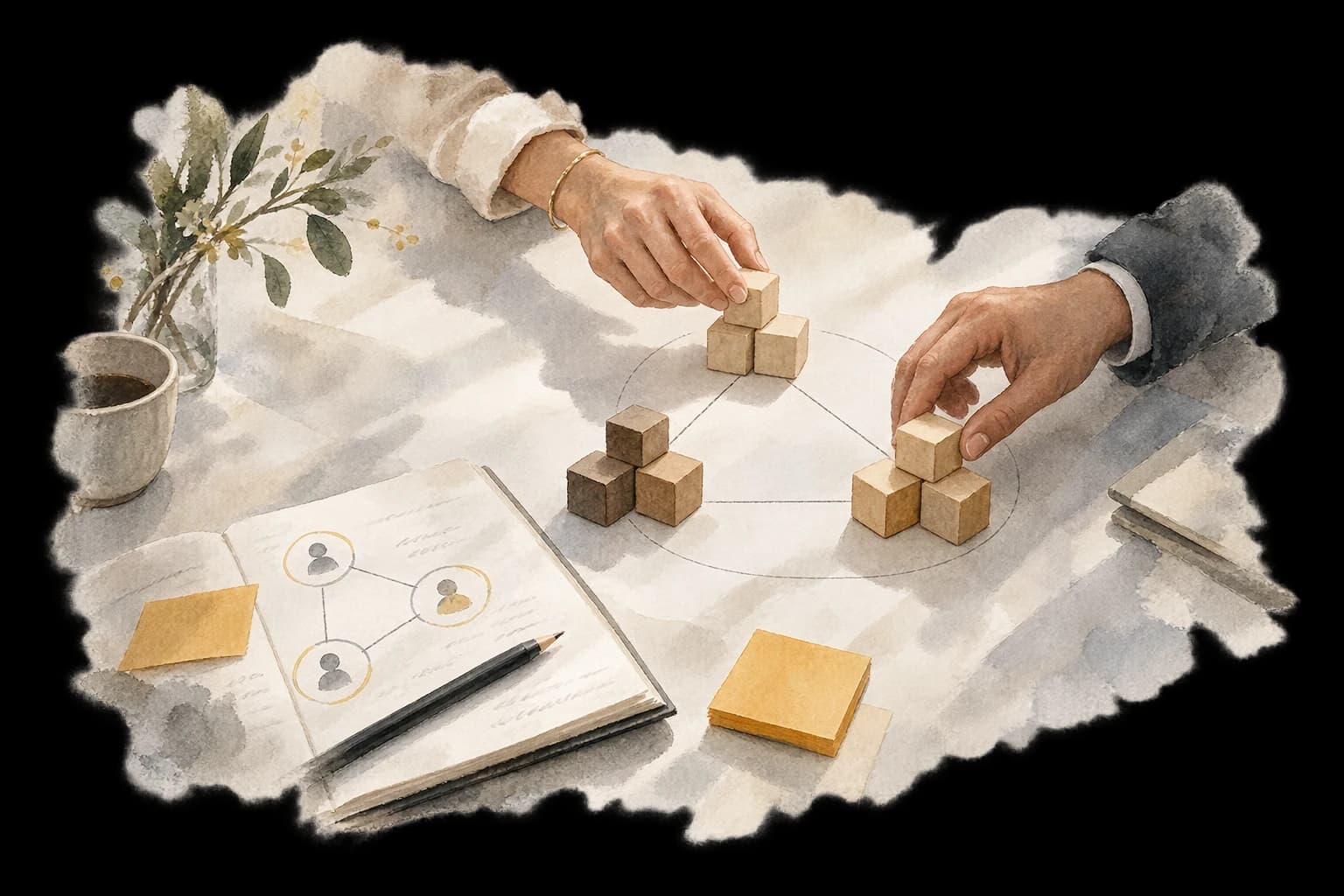
On the system
Adjusting the whole rather than correcting one isolated symptom.
A difficulty observed in one body can stem from the arrangements between shareholders. A shareholder tension can have its source in a family relationship. A problem at executive level can be sustained by a board that does not clearly exercise its role.
Associés en Gouvernance maps the roles, the rights, the bodies, the flows of information and the decisions. We look at how a change in one part will affect the rest of the system before recommending it.
Relationships
Belonging, trust, legitimacy, commitment and each person’s place.
See family governanceOwnership
Rights, power, liquidity, representation, entering and leaving the capital.
See shareholder governanceDecision
Board, management, committees, delegations, information and implementation.
See corporate governance

In the documents
Turning agreements into reference points people will actually use.
A charter, a shareholders’ agreement or a board charter is only worth something if it expresses decisions that are genuinely understood and owned. Associés en Gouvernance works ahead of the drafting and throughout it, so that the text is anchored in how the system really operates.
Depending on the subject, we draft these documents, or we develop them in consultation with the family’s and the company’s other advisers.

Two members of the team, one responsibility
Bringing two readings together stops a single interpretation taking hold.
The pair brings different experience to bear on the same situation. Both members of the pair take part in understanding the system, test their diagnoses against each other, and stay involved at the moments where judgement counts.
The client is not handed from a partner who sells the engagement to a team that then delivers it. The people who build the relationship are the ones who carry the work.
Complementarity
Their paths bring together a reading of relationships, shareholder experience, board practice, strategy and drafting.
Continuity
The same partners follow the interviews, the sessions, the feedback and the adjustments.
Shared responsibility
The diagnosis and the recommendations are discussed between the two before they are put forward.
A guiding thread rather than a standard method
The sequence may vary. The rigour remains.
Understand
Taking the measure of the history, the roles, the documents, the expectations and the tensions specific to the system.
Compare
Comparing perceptions, telling symptoms from causes, and giving back a clear-eyed reading.
Put people to work
Creating the individual and collective spaces the subjects at hand require.
Adjust
Acting at the right level: behaviour, role, right, governance body, process or document.
Support implementation
Being there when the new rules meet the reality of the people and the decisions.
This is not a protocol applied identically. The order changes, some steps recur, others come down to a single conversation. What does not change is the discipline: understand before proposing, say what has been heard, and stay present when the decision meets reality.
Why Associés en Gouvernance?
People above all. Nothing replaces lived experience.
Associés en Gouvernance has no executive search business. A recommendation on the composition of a governance body or on an executive’s succession never paves the way for a recruitment mandate.
Focused engagements
Board evaluation
Standing back from the board, its committees, individual contributions and its interfaces, then turning the evaluation into priorities for progress.
Explore board evaluationSeminars & training
Creating time for collective work to advance a strategy, a shared project or a redistribution of roles, or to strengthen each person’s ability to fulfil their mandate.
Explore seminars & training